
Datalogic PowerScan 9600 series
An industrial 2D handheld scanner, corded or cordless, sealed to IP67 and IP65 and tested to 50 drops from 2.5 m, with wireless charging on the cordless models.
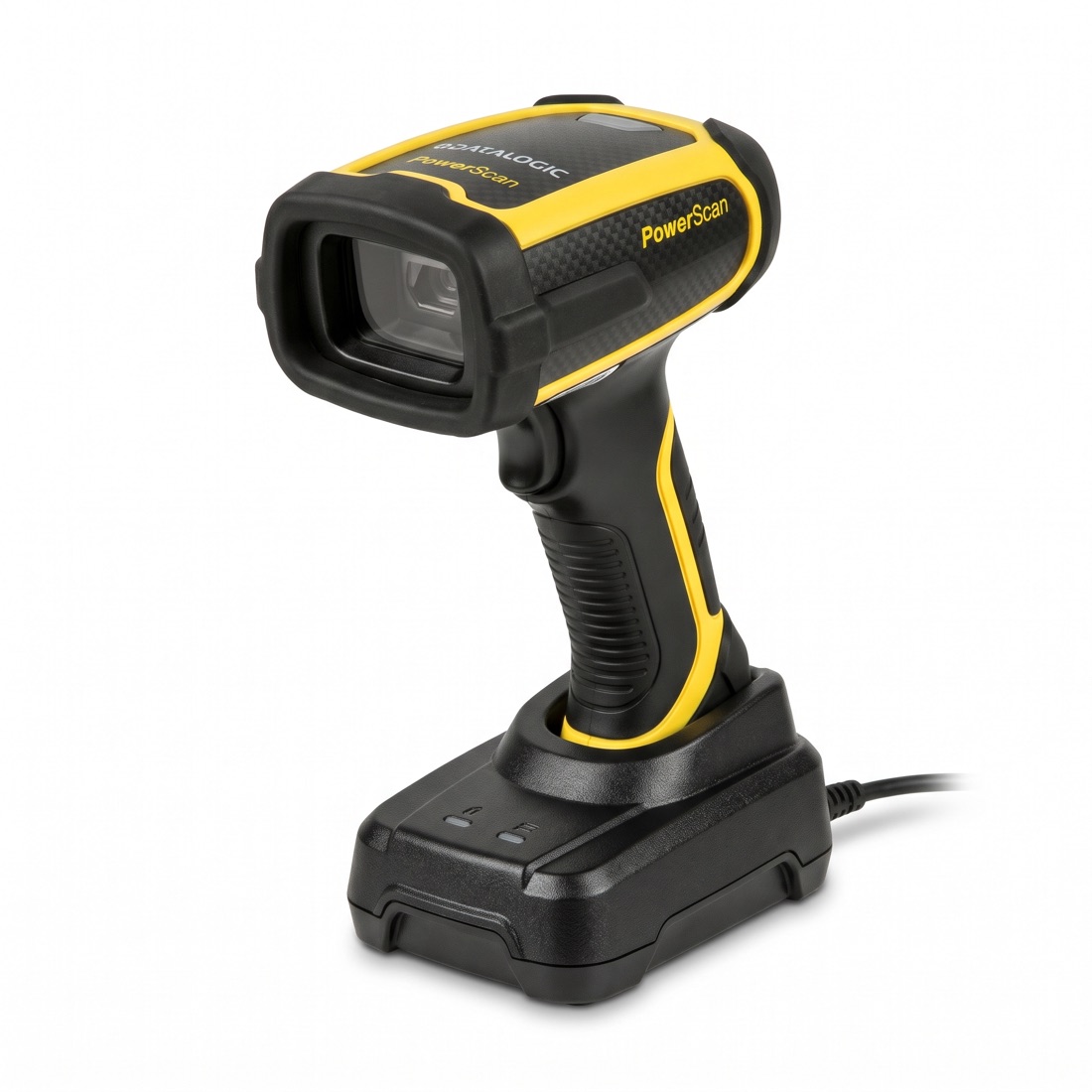
farthest reading distance, 100 mil Code 128, auto range models
protection rating, also IP65
50 drops onto concrete
lowest operating temperature, −30 °C on corded auto range models
Specification
The base model. Options change some of these figures.
Reading
- Optics
- Standard range (SR); high performance (HP), dual camera; document capture (DC), dual camera with colour sensor; auto range (AR); direct part marking (DPX)
- Sensor
- 1280 x 800 pixels
- Field of view
- SR and HP: 38° x 24°; DC: 51° x 33.5°; DPX: 38° x 29°; AR: 34° x 22° near field and 12° x 7.5° far field; horizontal by vertical
- Illumination and aimer
- SR, HP, DC: white LED and a 630 to 680 nm visible laser diode aimer; AR: red LEDs for near and far field, 650 nm aimer; DPX: white, red and blue LEDs, 650 nm aimer; laser Class 2 to IEC 60825
- Reading distance, SR
- Code 128 5 mil: 64 to 309 mm; Code 128 20 mil: 40 to 1037 mm; Code 128 40 mil: 55 to 1750 mm; EAN/UPC 13 mil: 40 to 675 mm; Data Matrix 10 mil: 64 to 300 mm
- Reading distance, HP
- Code 128 2.5 mil: 63 to 115 mm; Code 128 5 mil: 38 to 410 mm; Code 128 20 mil: 40 to 1570 mm; Code 128 40 mil: 55 to 2429 mm; EAN/UPC 13 mil: 40 to 1202 mm; PDF417 10 mil: 5 to 461 mm; Data Matrix 4 mil: 65 to 93 mm; Data Matrix 10 mil: 42 to 321 mm
- Reading distance, DC
- Code 128 5 mil: 31 to 397 mm; Code 128 20 mil: 35 to 1191 mm; Code 128 40 mil: 45 to 1866 mm; EAN/UPC 13 mil: 35 to 1020 mm; Data Matrix 10 mil: 42 to 302 mm
- Reading distance, AR
- Code 39 3 mil: 130 to 950 mm; Code 39 20 mil: up to 6000 mm; Code 128 40 mil: up to 10,000 mm; Code 128 100 mil: up to 20,000 mm; EAN/UPC 13 mil: up to 3200 mm; Data Matrix 10 mil: up to 1100 mm; Data Matrix 55 mil: up to 6500 mm; Data Matrix 100 mil: up to 10,000 mm
- Reading distance, DPX
- Code 128 2.5 mil: 25 to 98 mm; Code 128 5 mil: 25 to 169 mm; EAN/UPC 13 mil: 25 to 225 mm; PDF417 5 mil: 20 to 147 mm; PDF417 10 mil: 10 to 215 mm; Data Matrix 5 mil: 20 to 100 mm; Data Matrix 10 mil: 20 to 162 mm
- Reading distance, note
- Typical values, changing with label size, print resolution, contrast and ambient light; the nearest distance depends on symbol length and scan angle
- Maximum resolution
- SR: 1D 3 mil, 2D 6 mil; DC: 1D 3 mil, 2D 5 mil; HP: 1D 2.5 mil, 2D 4 mil; AR: 1D 2.5 mil, PDF417 3 mil, Data Matrix 5 mil; DPX: 1D 2 mil, 2D 4 mil
- Reading angle
- Pitch ±52°, roll 360°, skew ±52°; AR: pitch and skew ±60°
- Print contrast
- 15% minimum; AR: 20% minimum
- Scan rate
- 50 frames per second, maximum (cordless models)
- Read feedback
- Green Spot on the code, except on AR models; three green lights (3GL) on SR, HP, DC and DPX models; dual good-read LEDs; beeper with adjustable tone and volume; vibration
Codes
- 1D
- All standard 1D codes, including GS1 DataBar linear codes
- 2D
- Aztec Code, China Han Xin Code, Data Matrix, MaxiCode, Micro QR Code, QR Code, Dot Code
- Postal
- Australian Post, British Post, China Post, IMB, Japanese Post, KIX Post, Planet Code, Postnet, Royal Mail Code (RM4SCC); AR and DPX models read Portuguese Post and Swedish Post instead of British Post
- Stacked and composite
- EAN/JAN Composites, GS1 DataBar Composites, GS1 DataBar Expanded Stacked, GS1 DataBar Stacked, GS1 DataBar Stacked Omnidirectional, MacroPDF, MicroPDF417, PDF417, UPC A/E Composites
- Digital watermark
- Digimarc Barcodes (HP, DC and RFID models)
- Direct part marking
- DPX models read codes made by laser etching, dot peening, inkjet printing and electrochemical etching
Connections
- Interfaces
- RS-232, USB, USB-C, Ethernet, EtherNet/IP and PROFINET, through connection modules that exchange in the base station, or in line on the corded scanner
- Base stations
- BC9620: USB only; BC9630: RS-232 and USB multi-interface; BC9631: multi-interface, IP65; BC9680: Ethernet and PROFINET; BC9681: Ethernet, PROFINET and EtherNet/IP, IP65
- Bluetooth (PBT9600)
- Bluetooth 5.0 (5.2 on RFID models), Class 1, 2 or 3, SPP and HID profiles, 2.4 GHz; range 100 m in open air with the base station; up to 7 devices per base station; data encryption and scanner authentication
- STAR radio (PM9600)
- 433 MHz or 910 MHz (433 MHz only on AR and DPX models), two-way; up to 16 readers per radio receiver; range in open air at 433 MHz: 150 m at low speed, 100 m at high speed; at 910 MHz: 230 m at low speed with frequency hopping, 180 m at high speed
Unit
- Size, corded
- Height 190 mm, length 140 mm, width 79 mm
- Size, cordless
- Height 198 mm, length 150 mm, width 79 mm
- Weight, corded
- About 305 g (SR, HP, DC); 320 g (AR); 316 g (DPX)
- Weight, cordless
- PBT9600: 415 g; PM9600: 425 g, up to 455 g with display; AR models: 450 g, up to 480 g with display; DPX models: 435 g (PBT), 463 g (PM)
- Colours
- Yellow and black; DPX models black; RFID models black and blue
- Display and keys
- 1.8 inch OLED graphic display on selected cordless models, with a 4-key or 16-key configurable keypad
- Battery, cordless
- Removable lithium-ion pack, 3350 mAh; 80,000 reads per charge
- Charging
- Inductive, with no battery contacts; typically 3 h 15 min on 12 V external power, 2 h 50 min on 24 V, 6 h from a USB Type-C host, 15 h 15 min from a USB host; charge at 0 to 40 °C, ideally 0 to 35 °C
- Power
- Corded: 5 to 30 VDC ±5%; cordless base station: host powered 5 VDC ±5% or 10 to 30 VDC, external supply 10 to 30 VDC ±5%
Environment
- Protection
- IP67 and IP65; base station IP65 on specific models
- Drop
- 50 drops from 2.5 m onto concrete at 20 °C (the guide's cordless table gives 2.4 m); 50 drops from 2.0 m at −20 °C
- Trigger
- Withstands 10 million hits
- Operating
- −20 to 50 °C; corded AR models −30 to 50 °C; humidity 0 to 95%, non-condensing; ambient light up to 100,000 lux
- Storage
- −40 to 70 °C
- ESD
- 20 kV air discharge
Options
Optics Standard range reads low-density 1D and 2D codes at normal distances, high performance adds a dual camera for longer distances, document capture takes colour images, auto range reads far codes, and DPX reads direct part marks.
UHF RFID The 9600 RFID models read barcodes and read and write UHF RFID tags to EPC UHF Class 1 Gen 2 (ISO 18000-6C), at 865 to 868 MHz in Europe, up to 1 m from the front, and are sold in North America and Europe only.
Display and keypad Selected cordless models have a 1.8 inch OLED display with a 4-key or 16-key keypad.
Cordless radio Cordless models come as Bluetooth 5.0 (PBT9600) or as STAR radio on 433 MHz or 910 MHz (PM9600).
Base stations The BC9620, BC9630, BC9631, BC9680 and BC9681 base stations charge the cordless scanner and carry its interface.
Battery and chargers Datalogic lists the RBP-PM96 removable battery, the MC-P096-M2 and MC-P096-M4 multi-battery chargers for two and four slots, and the MC-P096-E2 two-slot extension.
Holder and vehicle mount Datalogic lists the HLD-P096 desk and wall holder and the VMK-P096 vehicle mounting kit.
Drivers and documents
- From Datalogic: the software, manuals and documents are on Datalogic's page for the PowerScan 9600 series.
- Set up as a fleet: Aladdin.
- Into your systems: how a scan reaches your ERP or warehouse system is on 3.5 Barcode and data capture.
Warranty
Datalogic states three years from the date of shipment against defects in materials and workmanship; its EMEA terms of sale cover batteries and other consumable parts for 180 days.
Status
The PowerScan 9600 series is current: Datalogic has announced no end of sale.
Older models and their successors are on 5.6 Discontinued models.
Around the device
Set-up: we set up the device and the data it sends, see 3.5 Barcode and data capture. Outside Switzerland, each visit is quoted.
Remote support: a fault in the connection to your system can be fixed without anybody travelling, see 8.5 Remote support.
Choosing one: what to compare between scanners and mobile computers is on 5.3 Scanners and mobile computers.
For the PowerScan 9600 series on its own or with its set-up and the connection to your systems, request a quote.
Last checked: 5 November 2026.
Preparing a validation, an inspection or a change to your labels?
The first engagement is free: a half-day review of your current label print chain, ending in a written list of gaps.